Flashcard · MusculoskeletalWhich nerve supplies the deltoid?
The axillary nerve, from the C5 and C6 roots. It also supplies teres minor.
Published source · page 934Owner-reviewed and published · Gray’s Anatomy of the Human Body, 20th ed. (1918)
Practice that adapts to you, review that remembers what you missed, and learning built from reviewed sources.

Chapter I
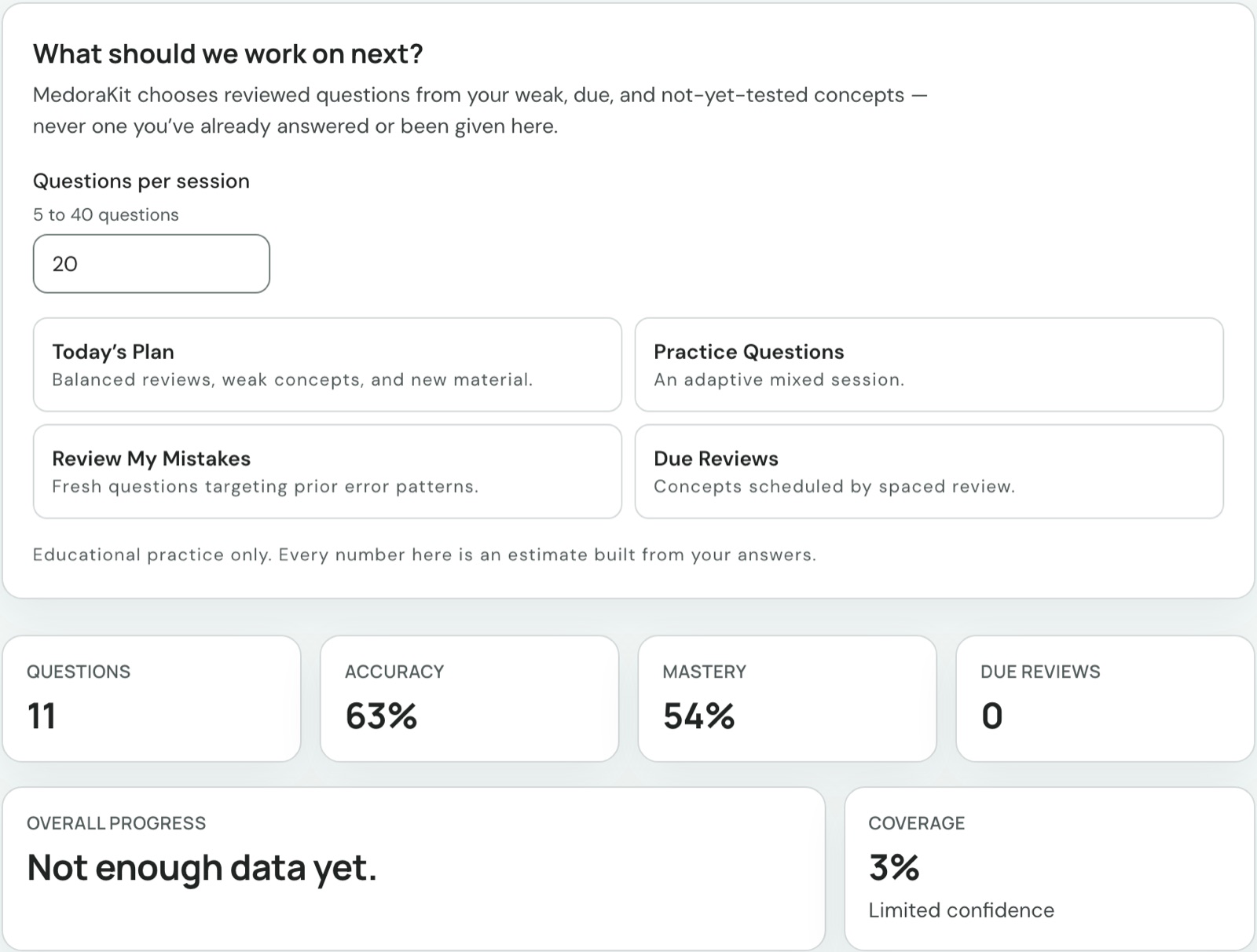
Every session starts from what you have already answered. A question you have seen is not served to you again by accident, and what you got wrong comes back when you are about to forget it.
Your plan gives you one clear next step. Your flashcard deck builds itself from your own answers. And your mastery is shown for what it is.
“Educational practice only. Every number here is an estimate built from your answers.”
Printed on adaptive practice in MedoraKit.
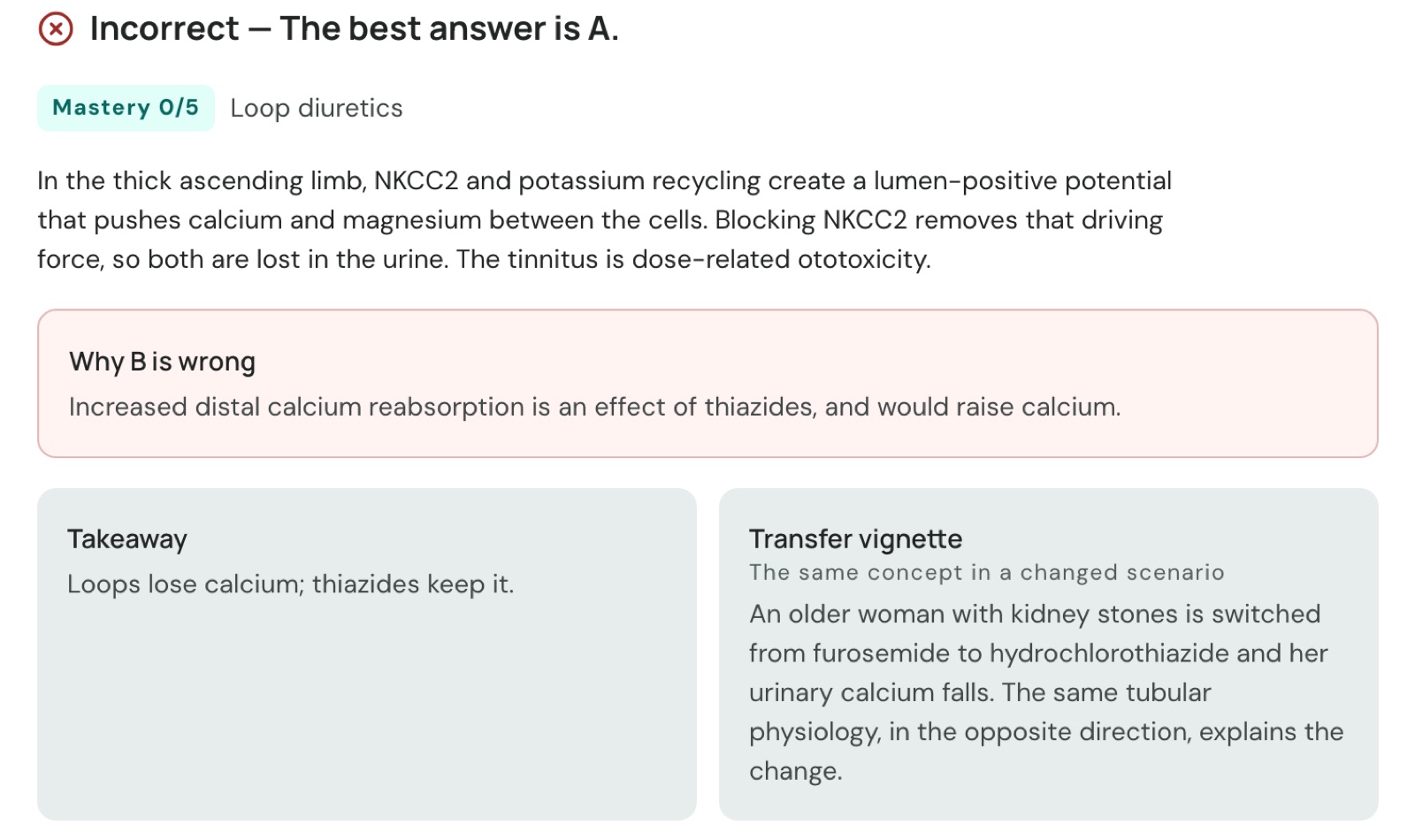
Why the right answer is right, why yours was wrong, a one-line takeaway, and the same idea in a new case, so you can check that it stuck.

Chapter II
Your progress, your deck and your plan stay with you. New workspaces appear in the same account as they open, so a new stage of your career never means starting again somewhere else.
One account covers everything: what you study and, when you register a practice, the clinic workspace.
Open a learning workspace and start practising, or complete doctor registration to set up a clinic for your team.
Answers, mastery and review schedules are remembered between sessions, on whichever device you pick the work back up on.
Each workspace is opened from the same account, and what you do in one never follows you into the other.
Sample card
The axillary nerve, from the C5 and C6 roots. It also supplies teres minor.
Published source · page 934Owner-reviewed and published · Gray’s Anatomy of the Human Body, 20th ed. (1918)
A sample, set in MedoraKit’s own format. In MedoraKit, sources are licensed medical references. This one is a public-domain text, so it can be shown here.
If a source is ever withdrawn, everything written from it is withdrawn too.
Begin today. Create an account, or sign in.
Practice material is written against cited sources and reviewed before it is published, never generated and left unread.
Passwords are stored only as one-way hashes, sessions expire, and an account can be recovered without anyone reading your data.
Nothing a patient tells you is ever used to personalise what you study, and nothing you study reaches a clinical record.